
Don’t fear imaginary failure
An excerpt from Chapter 9 of “Trial, Error, and Success: 10 Insights into Realistic Knowledge, Thinking, and Emotional Intelligence”

Chapter 9 of Trial, Error, and Success describes both positive and negative impacts of six basic emotions—fear, anger, disgust, sadness, happiness, and surprise. Here is the section about fear.
People experience a wide spectrum of fear intensities—from terror to trepidation—but the common feature is that some danger causes this emotion. If the danger is real, then the fear works in our favor as it guides us into safety. However, our uncertain world tricks too many of us to imagine dangers. For example, fear of failure is common, but instead of saving us, it frequently results in failure to succeed and lost opportunities.
Too many researchers lost their opportunity to develop blue light-emitting diodes (LEDs), even as they knew that blue LEDs would revolutionize office, home, and street lighting. Of course, these applications use white light in shades such as cool and warm, but a source of the high-energy blue photons is needed to create the spectrum of white light.
The material in all white LED lighting today is gallium nitride. Researchers observed emission of blue light from gallium nitride in 1950s and then again in 1972.1 However, it took another twenty-two years to see commercial blue LEDs in 1994.2 The key problem was researchers’ trepidation that prevented them from trying this material. The feature they feared was a high density of misplaced atoms in the crystalline structure. These defects in the crystalline order didn’t pose any direct danger. They are only visible by special microscopes but are not harmful nanoparticles. What the researchers feared was the reactions of their colleagues if they decided to try this material and failed. In 1980s, the focus was on a nice-looking material—zinc selenide—with a million times lower density of spatially disordered atoms. Not only was the nice-looking material more popular, but gallium nitride was also actively discouraged by statements that it had no future.
Universities encourage their researchers to try and find new things. In addition to teaching, this is the core business at universities. In this business, the researchers routinely turn around failed trials into new knowledge, whether this would be a new theory or a new direction for additional experiments. However, it was difficult to sell in this way failed experiments with gallium nitride. People would say it was stupid to spend time and money playing with such a defective material when there was a much cleaner option. The fear from being regarded as stupid by the research community flocked almost everyone into a worldwide group working with zinc selenide. Almost endless failed experiments and theories didn’t really matter. The researchers were happily exchanging their experiences and new theories in published papers and at conferences. There was no trepidation to continue this work because there was no danger to be seen by the peers as a stupid person.
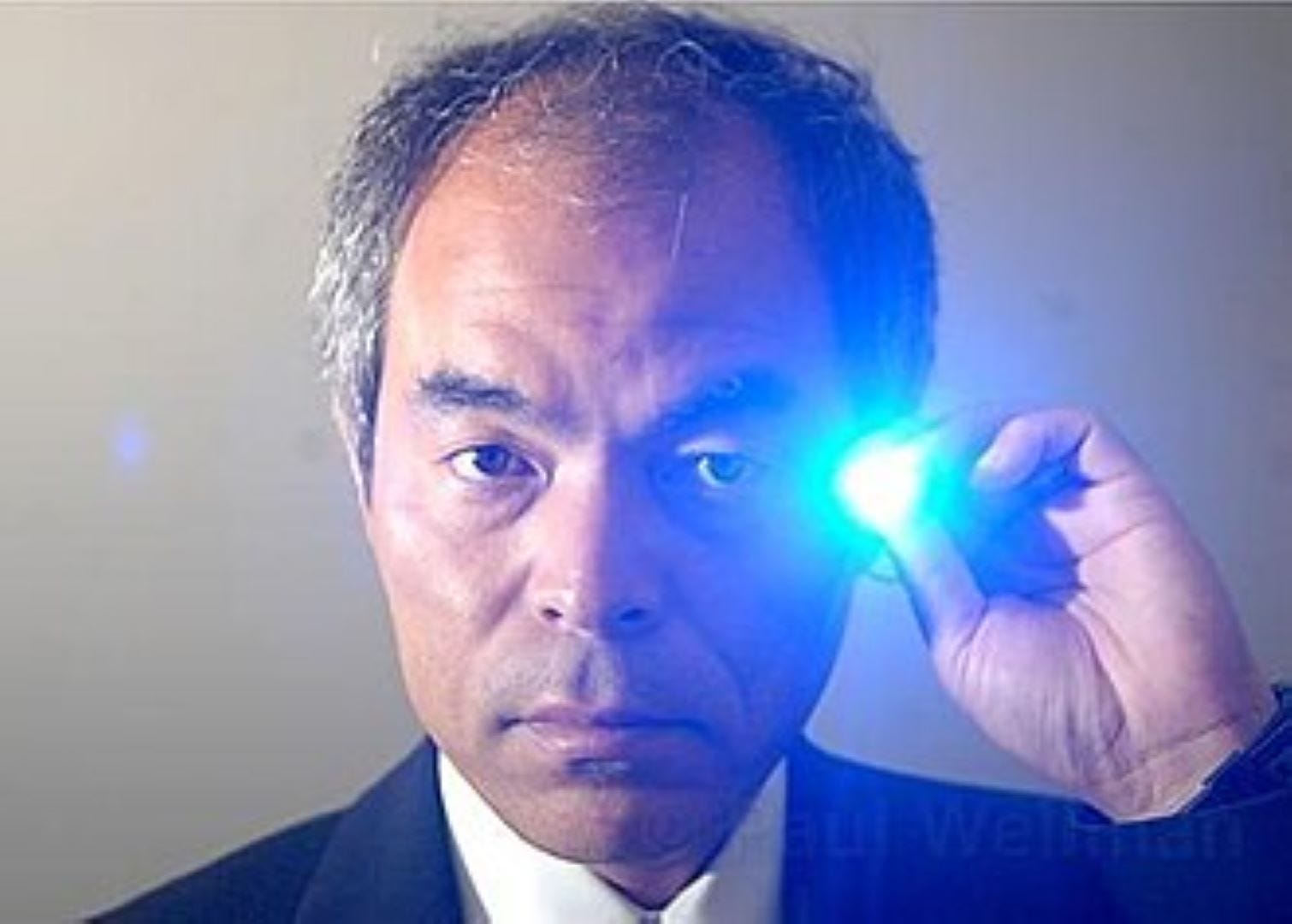
At the 1992 conference of the Japan Society of Applied Physics, approximately 500 researchers attended the sessions on zinc selenide. In contrast, the gallium-nitride session attracted five people. Three of them would eventually win and share the Nobel Prize for the invention and commercialization of blue LED. These three people were Professor Isamu Akasaki as the Session Chair, his student Hiroshi Amano as the speaker, and Mr. Shuji Nakamura in the audience.
In his Nobel Lecture3, Nakamura told us his reason for the decision to work on gallium nitride for blue LEDs. The reason was not his confidence that a successful development of this LED was possible. His objective was to get a PhD degree. In the late 1980s, Nakamura worked at the University of Florida as a visiting researcher. Because he didn’t have a PhD and had no published scientific papers, his colleagues there threated him as a technician. This relegated his role to helping others, without an opportunity for his name to appear on published papers and patents. Frustrated, he looked for the easiest way to solve this problem. At the time, he could be awarded a PhD degree in Japan without the need to enroll in a university. All he needed to do was publish five scientific papers. He was confident he could do it if he avoided the fierce competition by joining the niche work by Akasaki and Amano.
A US-based conference in 1993 showed that only three notable researchers were working on gallium nitride: Akasaki, Amano, and Nakamura. Thousands of other people were in the group devoted to the nice-looking zing selenide. Nakamura was not in the big ruling group by his own choice, and he didn’t fear their derisive opinion. It was not his aim to develop blue LED and he didn’t care about the prevailing view that gallium nitride had no future. His aim was to publish at least five papers and, with that aim, he felt safe working alongside Akasaki and Amano. At the time he was employed by Nichia Chemical Corporation in Japan, and he extorted funding for the development of blue LED by threats to resign from the company.4 These resignation threats were extraordinarily risky in terms of future employment in Japan, so they demonstrate his commitment to the aim of obtaining a PhD degree and his confidence in the paper-publishing plan.
Nakamura’s success ended up being much bigger than his plan. Not only did he receive a PhD in 1994, but Nichia also manufactured commercial blue LEDs in the same year. The road toward twenty-first century lighting with LEDs was open.
The density of gallium-nitride defects, feared by the scientists in 1980s, remains high in today’s LED material. It is much higher than the perceived threshold for efficient light emission, and not even close to the levels of the nice-looking zinc selenide. Fear from the imagined certainty that these were killer defects prevented highly-qualified researchers from trying gallium nitride, even when the potential reward was as great as a revolution in lighting—a great benefit for both the society and the innovators.
Here are the titles of the remaining sections in Chapter 9 of Trial, Error, and Success:
Link the facial expressions of emotions to the knowledge they communicate
A way of unleashing anger to achieve a positive outcome
Using disgust to express moral outrage
The value of disconnecting sadness from causality
Make sure you understand the relationship between happiness and money
Do not aim for a life without surprises
B.G. Levi, “Nobel Prize in Physics recognizes research leading to high-brightness blue LEDs,” Physics Today, vol. 67, pp. 14–17, 2014; doi: 10.1063/PT.3.2606
I. Akasaki, “Fascinated journeys into blue light,” Nobel Lecture, December 8, 2014; https://www.nobelprize.org/uploads/2018/06/akasaki-lecture.pdf
S. Nakamura, “Background story of the invention of efficient blue InGaN light emitting diodes,” Nobel Lecture, December 8, 2014; https://www.nobelprize.org/uploads/2018/06/nakamura-lecture.pdf
A. Yang, “The story behind Shuji Nakamura's invention of blue LEDs,” LEDinside, October 14, 2014; https://www.ledinside.com/news/2014/10/the_story_behind_shuji_nakamuras_invention_of_blue_leds